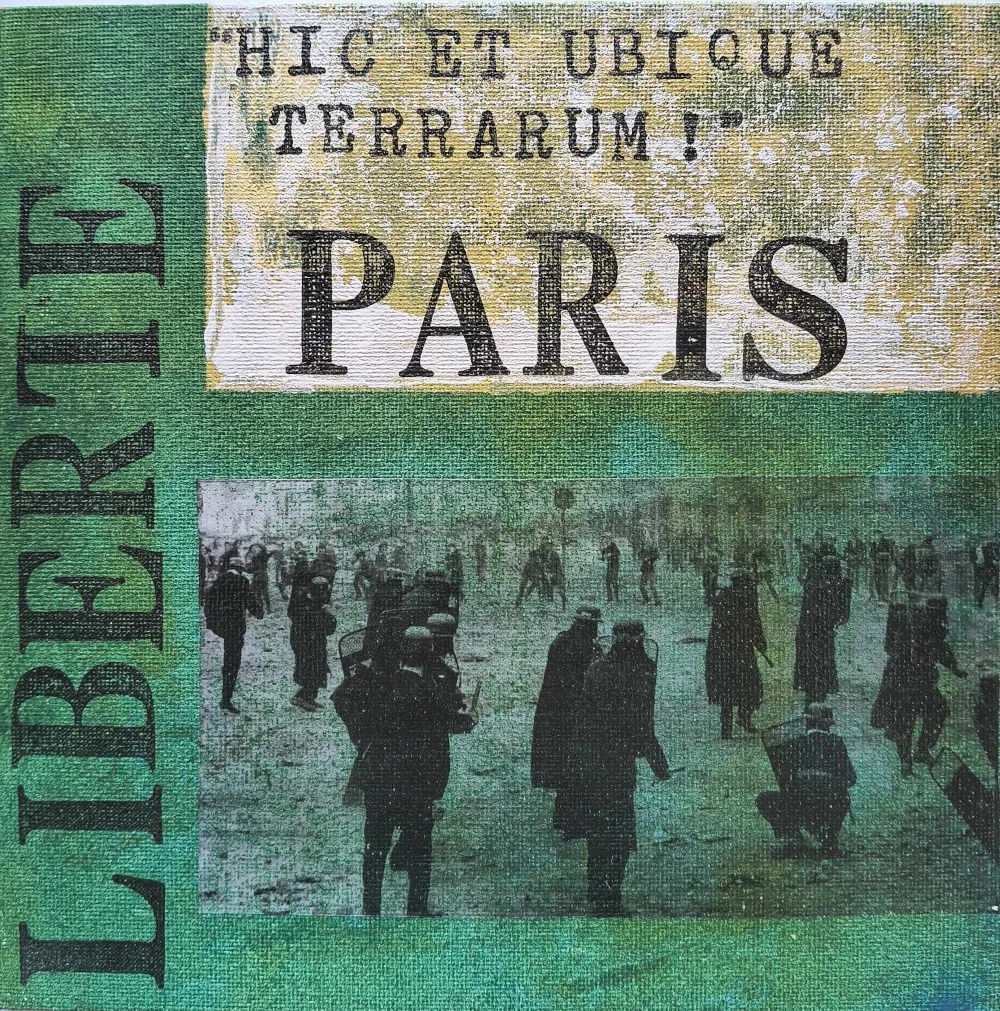
NO #17
20cm x 20cm, mixed media on canvas board £250
From the NO! 1968 forthcoming exhibition
NO! 1968
9–14 November 2026
1968 was a year of refusal. Across Northern Ireland, Paris, the United States and Vietnam, demands for civil rights, opposition to war and challenges to established authority repeatedly collided with power.
In NO! 1968, Dameon Priestly returns to the political and visual language of that turbulent year. Through collage and paint, image, text, colour and surface are brought together: imagery is cropped, repeated and obscured, while words including DEMOCRACY, LIBERTÉ, ONE MAN ONE VOTE and THE WHOLE WORLD IS WATCHING become integral to the compositions.
The history also has a personal connection. Priestly's grandfather took part in the People's Democracy march in Belfast in 1968, while his parents and extended family participated in civil rights marches and protests against the Vietnam War.
The exhibition explores the uneasy distance between political ideals and lived reality, and between historical events and the stories subsequently told about them.
The events belong to 1968. The works do not allow them to remain there.
Opening times
Monday: 11.30am–6pm
Tuesday–Thursday: 10.30am–6pm
Friday: 11.30am–6pm
Saturday: 10.30am–2.30pm
My work explores the intersections of identity, history, culture and power, examining how individuals, events and ideas shape our understanding of the world. Moving between portraiture, drawing, painting and mixed media, my practice is rooted in curiosity, research and an interest in the complexities and contradictions of human experience.
I draw my subjects from across cultural, social and political history: artists, writers, musicians, performers, political figures and movements that have challenged convention or influenced the course of events. Some are familiar, others have been overlooked or marginalised. What connects them is not a single ideology or historical narrative, but my interest in their lives, their circumstances and the wider forces that shaped them.
Personal connections, historical discoveries and questions about the present can each provide the starting point for a new body of work. Research informs my practice, but I do not intend the resulting artworks to be illustrations of historical events or definitive accounts of their subjects. Instead, I use the possibilities of visual art to explore, question and sometimes unsettle established interpretations.
My approach to materials and composition is integral to this process. Working across different scales and surfaces, often with materials that demand considerable precision, I combine meticulous observation with experimentation. Images may be isolated, repeated, fragmented or obscured; text can become an essential part of the composition, carrying meaning while also being transformed by colour, scale and its relationship with surrounding imagery. Layering, texture and the physical qualities of each surface contribute to works that range from quiet, intimate portraits to more confrontational compositions.
Across my collections, recurring themes of identity, rebellion, creativity, political authority and cultural change emerge, although no single theme defines my practice. I am interested not only in those who challenged established systems, but also in the systems themselves, the contradictions within them and the ways in which history is recorded, represented and remembered.
At the heart of my practice is a willingness to look beyond familiar accounts and examine what lies beneath them. I do not seek to prescribe a response or offer a single interpretation. Instead, I aim to create space for questioning, inviting viewers to look more closely at individuals and events, reconsider what they think they know and recognise the continuing relationship between history and the present.
For me, art is not simply a means of representing the past. It is a way of engaging with its complexities, exploring its relevance and giving visual form to questions that remain unresolved.


Quisque iaculis facilisis lacinia. Mauris euismod pellentesque tellus sit amet mollis.